
The Forty-Hour Platform
Five planks, one for each weekday, eight hours apiece: a plan for welfare reform Connecticut can set a watch by. Tuesday carries the 40-hour work requirement. Friday carries a clipboard.
One week, five planks
The work week is forty hours long, so the platform is too. We were not going to write one we could not finish by Friday.
Each plank is a weekday, and each weekday is eight hours. Monday cuts. Tuesday counts. Wednesday covers. Thursday bills. Friday repeals, or at least begins the process.
Every plank below is set out the same way: what we want, how it works, what the critics say, and our response. The critics get a full section because the Chairman believes in hearing the other side out. He prefers to hear it before 7 a.m.
Two of the planks depend on each other. Thursday pays for Wednesday. We put them side by side on the calendar so the money would not have far to travel.
On the record
- Adopted
- 2023, in Mansfield
- Method
- A show of pay stubs
- Planks
- Five, one for each weekday
- Hours
- Eight a plank, forty a week
- Amendments
- None
- Endorsements
- None, from anyone
Monday
Cut the dole.
What we want
We want Connecticut to spend less on welfare and carry fewer people on the rolls. The state has run assistance programs for decades and, as far as we can tell, has never once asked one of them to show up early.
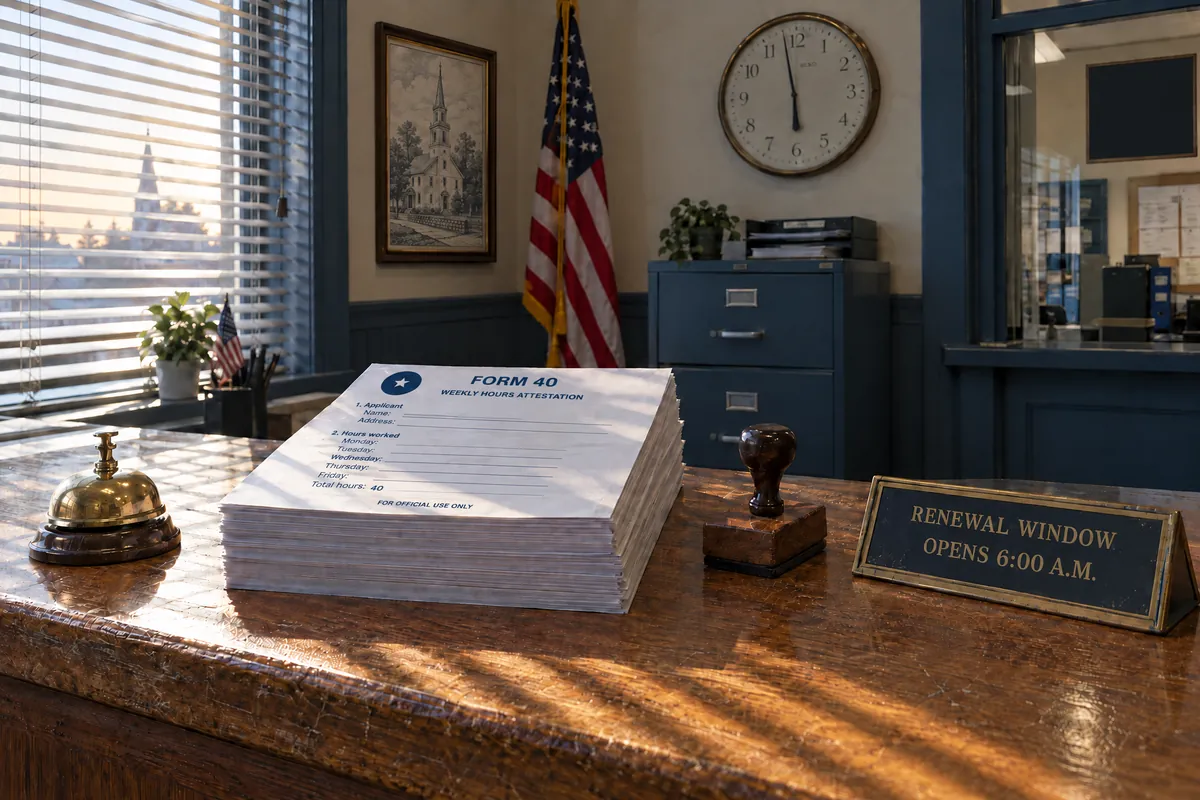
So every program gets a sunset date. On that date the program ends, unless it re-applies for its own existence on Form 40, in person, before 7 a.m.
How it works
- Every state assistance program is issued a sunset date. The date is printed on a manila card and mailed to the program’s office. It is always a Monday.
- On that Monday the program reports to the renewal window. The window opens at 6:00 a.m. and closes at 7:00 a.m. There is one window.
- The program brings Form 40, in triplicate, and its own folding chair. The form asks two questions: what do you do, and could you do it for less. The answers have to fit on the card.
- A program that makes its case is renewed for one year, on the spot, with a stamp. A program that arrives at 7:01 has sunset.
- The savings are counted that afternoon and announced at the next rally, from the flatbed.
Look at who is standing in that line. It is the program. Nobody who receives help fills out a new form, waits at a new window or gets up any earlier under Monday. For once, the paperwork has to do the paperwork.
I will staff the window myself, unpaid. My one condition is that it face east.
What the critics say
Critics say a sunset date on everything would have the programs that work spending their year proving they exist instead of doing the work. They say one hour at one window is not a serious review of anything. And they say that cutting first and reviewing second is the wrong order, because the people who lose in the meantime are the people who were counting on the help.
Our response
We have stood in lines. A line concentrates the mind. A program that is doing good work should be able to say so on one card, before seven, like anybody else clocking in. The ones that can will be renewed, and the Chairman will stamp them himself.
As for the hour: it is the same hour everyone gets. We did not invent six o’clock. We only show up for it.
On the people counting on the help, the critics have a point, and it is the reason the plank is built the way it is. They are not the ones in line. The program is.
Tuesday
Forty or nothing.
What we want
A 40-hour work requirement for any state assistance of any kind. Forty hours a week on the card, and the help is yours. Thirty-nine does not round up.
We did not pick the number. The work week did. All the plank asks is that the state read the same clock the rest of us punch.
How it works
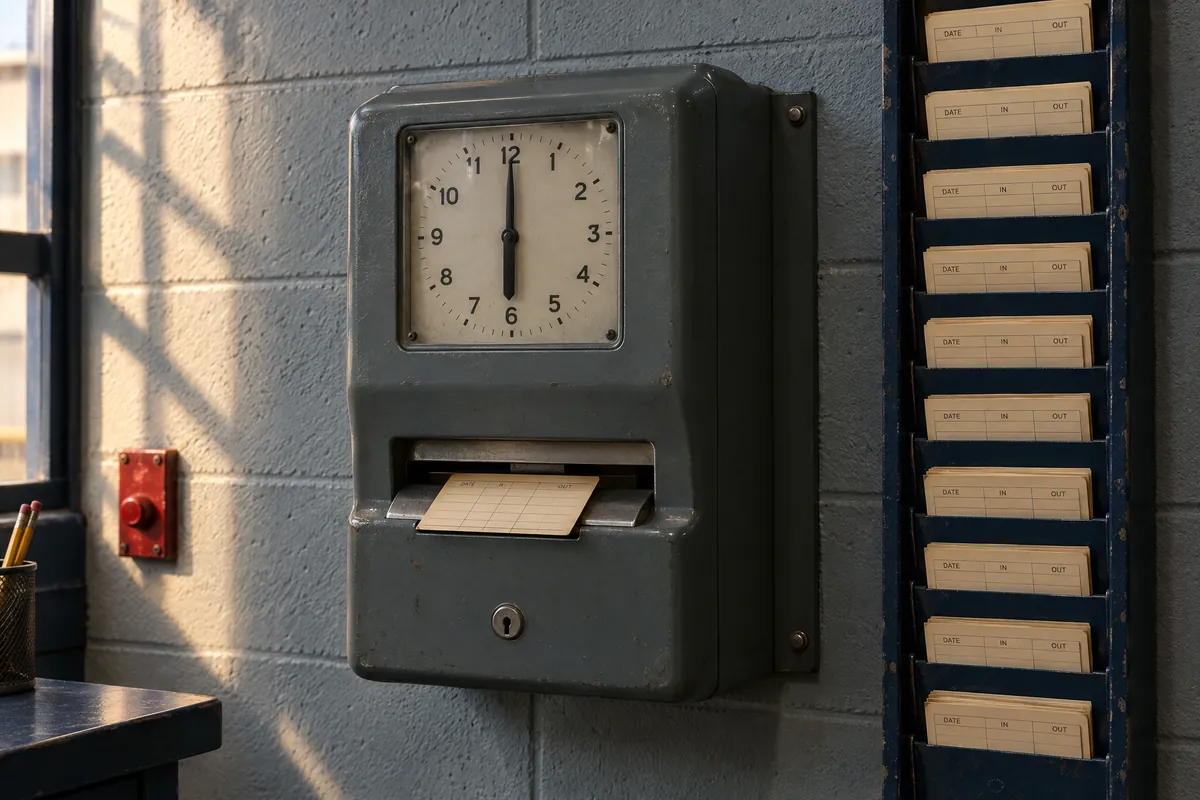
Hours are counted the way hours have always been counted: on a punch clock, in ink. Every able-bodied adult covered by the plank is issued a weekly time card. The week opens Monday at 6:00 a.m. The card is totaled on Friday.
Most of the questions we get are about what counts. This is the current list.
- One job
- Every hour on the clock, including the ones before the boss gets in.
- Two jobs
- Both, added together on one card. We are not going to make you pick.
- Job training
- Counts, if you punch in for it.
- Raising children
- Counts. The Chairman put the question to the Treasurer, and she said yes without looking up. It is the only thing she has ever approved.
- Mowing the lawn
- Counts, if you punch in. The Chairman does.
- 39 hours, 59 minutes
- Thirty-nine.
- 41 hours
- Forty. Nobody is paying overtime on this card.
Children are not covered by Tuesday. They are covered by Thursday.
What the critics say
Critics say most adults who receive assistance and are able to work already do, often at jobs that will not schedule them for forty hours however early they show up. They say the plank punishes a person for an employer’s calendar. They say the cards, the clocks and the counting would cost more than the plank saves. And they say a rule with no rounding is a rule built to be failed at thirty-nine and a half.
Our response
We will give the critics the one about schedules. A person cannot work an hour that nobody will give them. So the plank counts an hour that was asked for and refused against the employer, not the worker. We do not yet know what that means. The Chairman said it at a rally in Lower Quinnebog, it got applause, and it has been in the platform ever since.
On rounding we will not move.
Rounding is how forty turned into thirty-seven and a half. A number that can be rounded is a suggestion.
On cost: it is one card per person per week. We have priced the cards. They are manila, and they come five hundred to a box.
We hold ourselves to the same clock. The Chairman has not rounded his own hours since 1983, and he has the cards.
Wednesday
Mandatory minimums, for healthcare.

What we want
A mandated minimum of healthcare for every resident of Connecticut. In committee we call it mandated healthcare mandatory minimums. Nobody has moved to shorten it. Other people use mandatory minimums for sentencing. We use them for checkups.
It has two parts: a floor of coverage that no resident falls below, and one required checkup a year. Not less than one.
How it works
The floor. Every resident is covered to a set minimum. We have not printed the full list of what is on the floor, because the Chairman keeps adding to it. As of this week it holds a family doctor, emergency care, prescriptions and, at his insistence, feet. He dispatched forklifts for a long time.
The checkup. Once a year, every resident reports for a physical. The appointment is at 6:00 a.m., because every appointment in this platform is at 6:00 a.m. Nobody can go in your place. A checkup you meant to schedule does not count.
The reminders. Miss the checkup and a reminder card comes in the mail. Miss it again and a second card comes. After that the Chairman calls from his line, (959) 263-7577, at 5:45 a.m., and asks how you are feeling. We do not expect anyone to need a second call.
The bill. Thursday pays it. Every dollar of Wednesday comes out of the tuition collected under the Thursday plank. Nothing else in the state budget is touched, because nothing else in the state budget has been explained to us.
What the critics say
Critics on one side say a healthcare mandate is exactly the kind of government program that Monday was written to stand in a line at dawn. Critics on the other side say a floor nobody has finished defining is not a floor. Both sides notice that the plank is funded by a tuition bill sent to schoolchildren, and both ask whether we have run the numbers.
Our response
To the first group: yes. Wednesday gets a sunset date like everything else, and we expect it at the window before seven with its form filled out. We are not worried. It was raised right.
To the second: the floor is being defined. It gets a little higher every time the Chairman opens a medical bill.
To both, on the numbers: we have run them, and they come to forty. We accept that this is not the number they were asking about.
Thursday
$1,000 a year, every public school.

What we want
End the state subsidy to public schools and charge tuition in its place: $1,000 a year, per student, at every public school in Connecticut, kindergarten through twelfth grade. We call the result non-subsidized public schools. Nobody else calls it anything, because nobody else has proposed it.
The proceeds go to Wednesday. A child who pays tuition on Thursday is paying for a checkup on Wednesday, quite possibly their own. We find that tidy.
How it works
The bill is simple. The booth is simpler.
- The bill
- $1,000 per student, per year. Thirteen years, kindergarten through twelfth grade, comes to $13,000 and a diploma that is paid off.
- Installments
- Forty weekly installments of $25. The school year is thirty-six weeks long. The other four fall in the summer, which is how a child learns about July.
- The booth
- One at every front entrance. Cash or check, exact change only. The gate arm goes up at 6:00 a.m. We are told school starts later than that. The booth does not.
- The receipt
- Each payment is stamped on a card the student keeps. A full card is, as far as we are concerned, the report card.
- The money
- The state subsidy ends. The tuition does not stay at the school. It crosses the hall to Wednesday and pays for the healthcare minimum.
What the critics say
Critics say public school in this country is free on purpose and has been for a very long time. They say a thousand dollars a child is a real bill for a family with three kids and a rounding error against what it costs to run a school, so the plank manages to be too much and not nearly enough at once. They say that if the state stops paying and the tuition goes to healthcare, the school is left holding a toll booth. And they ask what happens to the child whose family cannot pay.
Our response
We will take those in order.
Free on purpose: we know. This is the one plank where the Chairman concedes that we are the ones changing something that was already there. He says that is what a plank is for.
Too much and not enough: both are true, and we have chosen to hear it as balance.
The toll booth: the school keeps the booth.
The child whose family cannot pay stays in school. Nobody is turned away at the gate arm. The balance carries forward, the card is stamped “owed” in red, and the Treasurer keeps the ledger. She has never forgiven a balance. She has also never collected one.
Friday
Repeal the credits.

What we want
Begin the repeal process for two federal tax credits: the Child Tax Credit and the Earned Income Tax Credit. Our position is that money should arrive in a pay envelope, not on a tax form. We want both credits gone.
We know what the word begin is doing in that sentence. It is doing most of the work.
How it works
These are federal credits. They are written into federal law, and federal law is made by Congress. The Foundation is a statewide advocacy group with one flatbed stage, and the stage belongs to the Rally Captain. We cannot repeal anything. We have checked.
So the plank begins a process. The process has three parts, and this is where each one stands.
- The petition
- 187 signatures. Thirty-one of them are the Chairman’s, collected at different rallies. The Treasurer has disallowed thirty.
- The letter
- Strongly worded and now in its ninth draft. Each draft has been stronger than the one before, so none of them has been mailed. It is kept in the glove box of the Altima.
- The clipboard
- On the Clock Me Wrong table at every rally, with a pen on a string. The string was a compromise.
One rally is given over entirely to the clipboard: the Clipboard Drive for the Friday Plank, in Saltbox Falls. Bring your own pen, in case of a line. There has not been a line.
What the critics say
Critics say these two credits go to people who work and people who are raising children, which is to say the people who would pass Tuesday with hours to spare. They say a platform built on work has picked a fight with two parts of the tax code that reward it. And they say a foundation in Connecticut cannot repeal a federal law.
Our response
The last point is correct. We said so ourselves, in the second paragraph of the letter.
On the rest: a wage is yours because you worked the hour. A credit is yours because somebody filled in a line. We are for the first kind of money. The Chairman would rather the hour simply paid more, and he has been told that is a different plank.
We will be honest about the scoreboard. Gus, a retired mailman, is the only person who has ever stepped up to the Clock Me Wrong table, and he has made the working-families argument to the Chairman’s face. The Chairman has debated Gus fourteen times and is 0–14.
It is not a losing streak. It is a rebuilding year.
How a plank is adopted
Nothing goes into the platform without passing the same five steps, in this order. The process has never been shortened. It was lengthened once, when the Treasurer found a sixth step and disallowed it.
-
Drafted
On the clipboard at the Clock Me Wrong table, in the Chairman’s important pencil.
-
Read aloud
From the flatbed stage at the next rally, at the posted time, to everyone who arrived on time.
-
Adopted
By a show of pay stubs. Late arrivals vote from the tardy pen, and their stubs are counted.
-
Costed
In the Treasurer’s green ledger. She has approved nothing to date and sees no reason to start now.
-
Filed
In the glove box of the Altima, with the letter to Congress, where it stays dry and is climate-controlled whenever the engine is running.
Questions about the platform
Asked at the Clock Me Wrong table, mostly by one retired mailman. Answered here so the Chairman can stop answering them out loud.
What is the Forty-Hour Platform?
It is the program of the satirical Connecticut MAGA Foundation, a fictional advocacy group from Mansfield, Connecticut: five planks, one for each weekday, eight hours each. Monday cuts state welfare spending. Tuesday sets a 40-hour work requirement for state assistance. Wednesday mandates a minimum of healthcare. Thursday charges $1,000 a year in public school tuition. Friday begins the repeal of two federal tax credits.
Why forty hours?
Because that is a full week on the clock: five days at eight hours. The Chairman has clocked in early every day since 1983, and he sees no reason to change the number now.
Does thirty-nine round up?
No. Thirty-nine and three quarters does not round up either. We were asked.
Who counts the hours?
A punch clock. A clock does not have opinions and it does not take calls. The Chairman keeps one in his garage and punches in to mow the lawn, so the equipment has been tested.
How does Thursday pay for Wednesday?
Every public school student is billed $1,000 a year under the Thursday plank, and all of it goes to the healthcare minimum in the Wednesday plank. The Treasurer’s estimate of the total is one thousand dollars times the number of students. She has asked the state for the second number, in writing, and is waiting.
Can a foundation in Connecticut repeal a federal tax credit?
No. Only Congress can change federal law. That is why the Friday plank says begin the repeal process. The process is a petition, a strongly worded letter, and a clipboard at every rally.
Is there a sixth plank?
No. A sixth plank would be overtime, and the Treasurer has never approved any. The platform does not cover the weekend. The rally schedule does.
Has anyone endorsed the platform?
No. No elected official, campaign, party committee or outside organization has endorsed the Forty-Hour Platform, and as far as we know none of them has heard of it. Printed copies are on the table at every rally. Nobody has taken the last one, or the first.
The people behind the planks are in Our story. The parking lot where the forty-hour idea started has a page of its own: The Founding.
The week starts Monday
You have read all five planks. The reading does not count toward your forty. Join the Foundation and we will see you at six.